Commercial messages on WhatsApp are spam, if done badly… and without Spoki
Content

Business communications on WhatsApp in the era of unwanted messages
How annoying is it to receive unwanted, commercial, or uninformative messages on WhatsApp from contacts you don’t even remember giving your number to? At Spoki, we help companies integrate WhatsApp and Conversational Marketing into their strategies, and we know how some types of communications can seem like spam. That’s why in the next paragraphs, we will explain why this happens and how, instead, WhatsApp can become a powerful tool for converting and retaining customers if used correctly.
Why can receiving communications on WhatsApp be annoying?
We live in a world dominated by endless stimuli generated by algorithms. Instagram, Facebook, and TikTok work precisely like this: we start interacting with content we like, and they suggest similar content, storing in their memory the topics we are most interested in. Essentially, we cannot 100% control everything we see.
Unlike social networks, WhatsApp and email are spaces that the user perceives as “in control”. In fact, to receive communications on WhatsApp and email, it is necessary to leave your contact information and be aware that you are giving consent to receive commercial marketing communications.
This option, through which consent is requested, is called Opt-In, and if you are sending commercial communications without this having occurred first, there is a problem.
So: the answer to the question “Why can receiving communications on WhatsApp be so annoying?” is simple: users want to have control over the information they receive through messaging platforms like WhatsApp and, moreover, if the messages are poorly structured, are too insistent, do not have a description etc. they can be even more annoying and be perceived as spam.
“Definizione di spam: invio di messaggi commerciali indesiderati o non richiesti, principalmente a carattere commerciale”.
Here are the key points to having a strategy that works:
• Messages can only be sent to people who have left their contact information;
• pay attention to the tone of voice, the visual, the call to action, etc.: they must be consistent with each other and empathetic;
• content is king, really! It is necessary to think carefully about what is being sent, create value (yes, even if it is a commercial communication);
• it is important to send messages at the right time to the right people: segment your audience (you’re welcome);
• customer support: listening is a fundamental part of the sales process, even if they are asking you to remove their number or email from the contact list (it is their right).
Why use WhatsApp as a Conversational Marketing tool
Having understood the necessity of obtaining user consent to send messages, and having grasped a general understanding of user psychology, let’s explore why WhatsApp is an extremely effective Conversational Marketing tool.
Let’s start with some data:
• WhatsApp is the most used messaging platform, with approximately 2 billion monthly users worldwide;
• it has an opening rate of 98% (consider that the opening rate of newsletters is approximately 35%).
So, if your commercial communications are targeted, empathetic, and well-planned, then yes: WhatsApp is the perfect tool to increase sales on your commerce and build customer loyalty. Let’s see how.
The advantages of WhatsApp for Selling
Thanks to the Whatsapp Business and Spoki APIs, it is possible to:
• integrate your CRM and contact database;
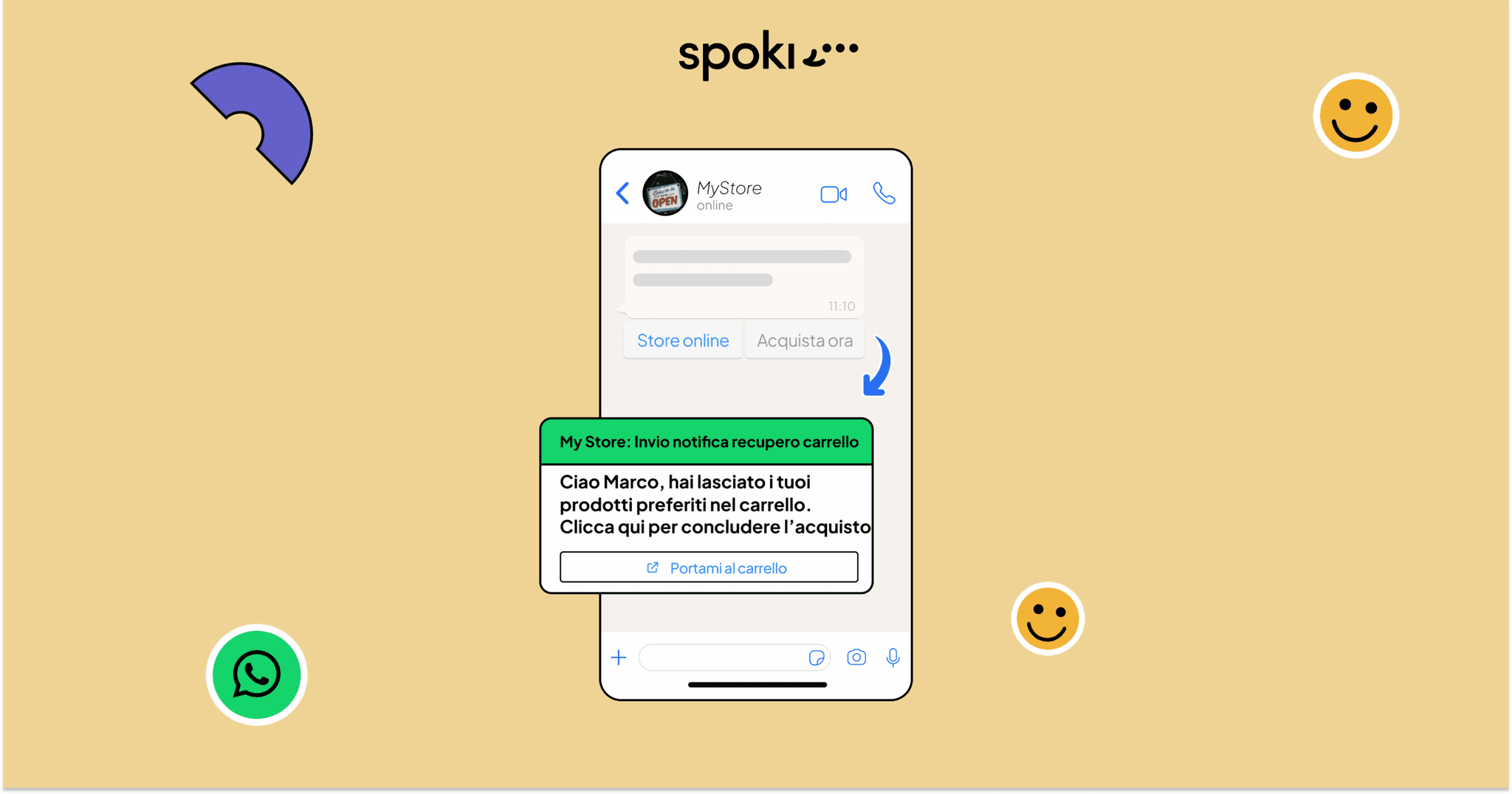
• integrate your commerce, with the possibility of making purchases directly on WhatsApp, thanks to PayPal;
• collect data and create personalized experiences for each user or cluster of users;
• automate communications, improving the user experience, also thanks to WhatsApp Marketing">artificial intelligence;
• scale your marketing operations, with a consequent reduction in time (both for the company and for the user).
How to Use WhatsApp to Send Commercial Communications Thanks to Spoki
We have a tone of voice, we have defined a specific target and a database of contacts integrated with Spoki, therefore, we can see how to use WhatsApp as a conversational marketing tool:
• define your objective (NPS, conversion, awareness, etc.);
• create specific templates for each contact list (personalization is the key);
• create your campaign by scheduling the sending of messages to your lists;
• Integrate Meta and Google campaigns with direct CTA to WhatsApp;
• analyze campaign data to further optimize your strategy.
In conclusion: if the message arrives in the right way and at the right time, you’re done!
Do you want to integrate WhatsApp Marketing into your business?
Start with a free account on Spoki and start your first campaigns with 5€ of included credit.
Or contact us to build your winning strategy together. We are waiting for you!