Content
Agentic commerce lets software do the shopping with the customer, in conversation, rather than watching from a distance. For years, online shopping meant a customer clicking through a website while software stayed on the sidelines. Now the battleground is shifting from the web to the chat thread.
What agentic commerce means
Agentic commerce is a model in which an autonomous AI agent handles the entire purchase journey inside a single conversation. Rather than presenting a catalog and waiting for clicks, the agent qualifies the buyer and recommends products. Then it negotiates where appropriate, completes checkout, and follows up after the sale — end to end.
The key word is autonomous. This is not a chatbot that answers a question and links you to a product page. Instead, it is an agent that carries the buyer from “I’m looking for something” all the way to “thanks for your order,” making decisions along the way.
The distinction from traditional e-commerce
Classic e-commerce fragments the purchase across surfaces. There is a search page, a product page, a cart, a checkout, an email receipt, and a follow-up campaign. Every transition is a place to lose the customer.
Agentic commerce collapses those surfaces into one continuous exchange. Because the context never resets, the whole path lives in a single thread. That continuity is not a cosmetic improvement, either.
Cart abandonment, upsells and re-engagement all get harder every time the buyer has to switch context. Therefore, keeping the journey in one conversation removes most of those seams.
There is also a trust dimension. In a fragmented flow, the buyer restates the same details at each step, which feels impersonal and slow. In a single thread, the agent already knows the context, so the exchange feels less like filling in forms and more like talking to a knowledgeable shop assistant.
The competitive landscape
Several major players are racing to own this space, and most are aiming at the open web:
- Shopify Sidekick brings agent capabilities to the merchant side of the Shopify ecosystem.
- OpenAI Operator pursues a general-purpose agent that can browse and act across websites on a user’s behalf.
- Perplexity Shop layers shopping onto an AI answer engine, turning research into purchase.
These are serious efforts, and each is credible in its own arena. What they share is a bet on the browser. In each case, the agent operates across websites, standing between the shopper and the open web.
That positioning has real advantages. The open web is vast, and an agent that can traverse it reaches almost any store. It also fits how many people already research big purchases, comparing options across many tabs before deciding.
The trade-off of the web-first bet
Operating across the open web is powerful, yet it also inherits the web’s friction. Pages load, sessions time out, and attention wanders between tabs. An agent that lives in the browser still has to fight for the shopper’s focus. That is precisely the friction messaging removes.
Why WhatsApp changes the equation for agentic commerce
There is a different bet available. It holds that agentic commerce belongs on the highest-engagement channel people already use every day. Messaging is where customers actually reply, and WhatsApp in particular combines reach with the intimacy of a personal thread.
An agent that lives there does not ask the buyer to visit a new surface. Instead, it meets them where the conversation already is. This continuity depends on solid conversational infrastructure, and a capable WhatsApp AI agent that reasons and calls tools is what lets the purchase actually complete in chat.
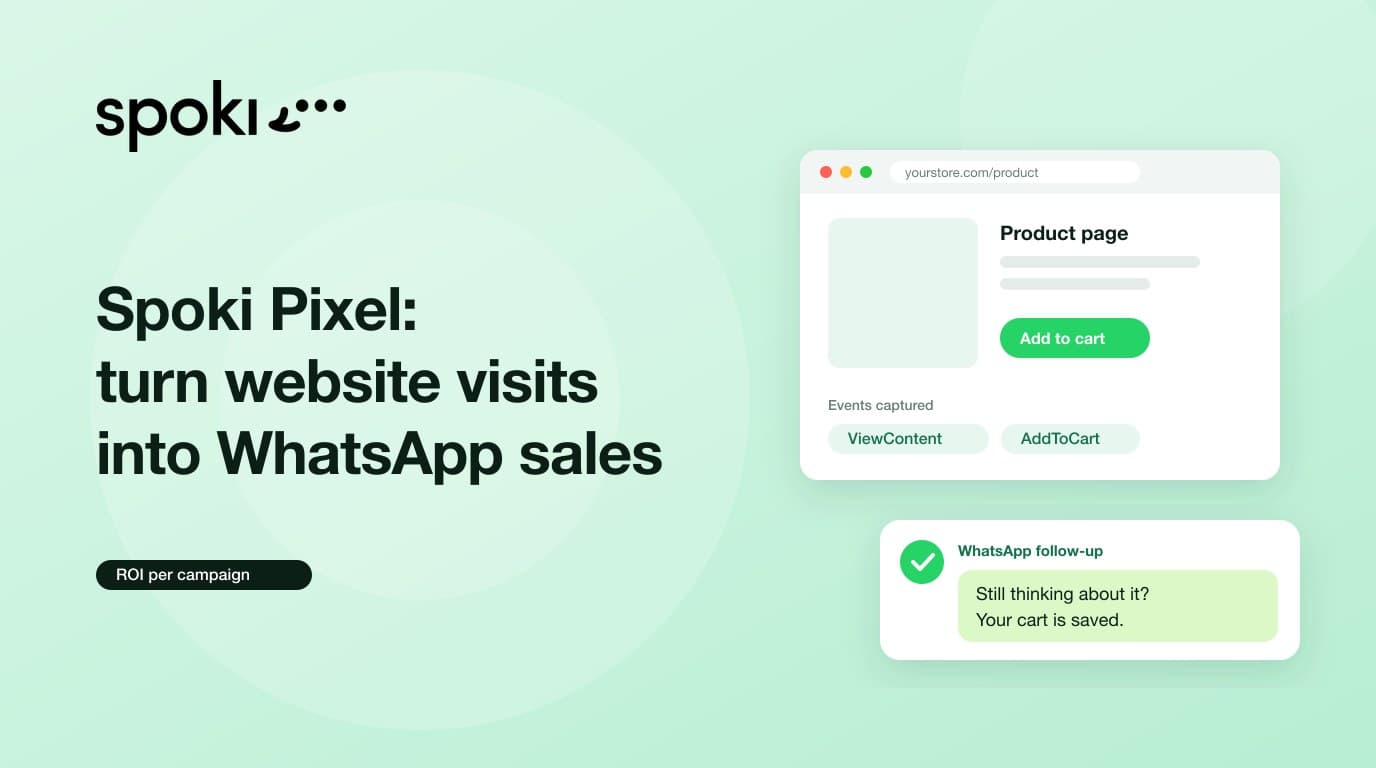
The payoff shows up most clearly in cart recovery. When the entire purchase path stays inside one conversation, there is no cold email trying to drag the customer back to an abandoned session. Recovery becomes a natural continuation of a chat that never really ended. That is why WhatsApp-based recovery can reach around 41% of abandoned carts, compared with 5-10% for email-only flows.
That gap is not a small optimization. Roughly speaking, it is the difference between recovering one lost sale in ten and recovering four. For a store with meaningful volume, that alone can reshape the economics of paid acquisition, because far fewer of the visitors you pay for slip away for good.
How Spoki approaches it
Spoki applies the agentic model specifically to WhatsApp. Its Sales AI Agent browses the catalog and recommends products by combining live inventory with the customer’s profile. It also sends payment links, requests the shipping address, and follows up after the purchase — all within one chat thread.
Underneath, a conversational CRM persists the full history. As a result, the agent’s recommendations and follow-ups are grounded in everything the customer has said and bought before, rather than starting cold each time. This persistence rests on an AI-native CRM where the inbox is the record, so the store and the memory are the same object.
The design intent is to make the conversation the store. Qualification, recommendation, payment and post-sale all happen in the same place, with context intact from first message to reorder. In other words, the thread is not a support channel bolted onto a shop; it is the shop itself. It all runs on the WhatsApp Business Platform, which provides the programmatic backbone for the channel.
The takeaway
Agentic commerce is coming either way, so the open question is where it lands. The web-first players are betting on the browser. The messaging-first approach bets on the channel where people already engage most.
For businesses whose customers live in WhatsApp, keeping the whole purchase in one conversation is not just tidier. Ultimately, it is the difference between recovering one abandoned cart in ten and recovering four.