AI Phone Agent: What It Is, How It Works and When to Use One
Content
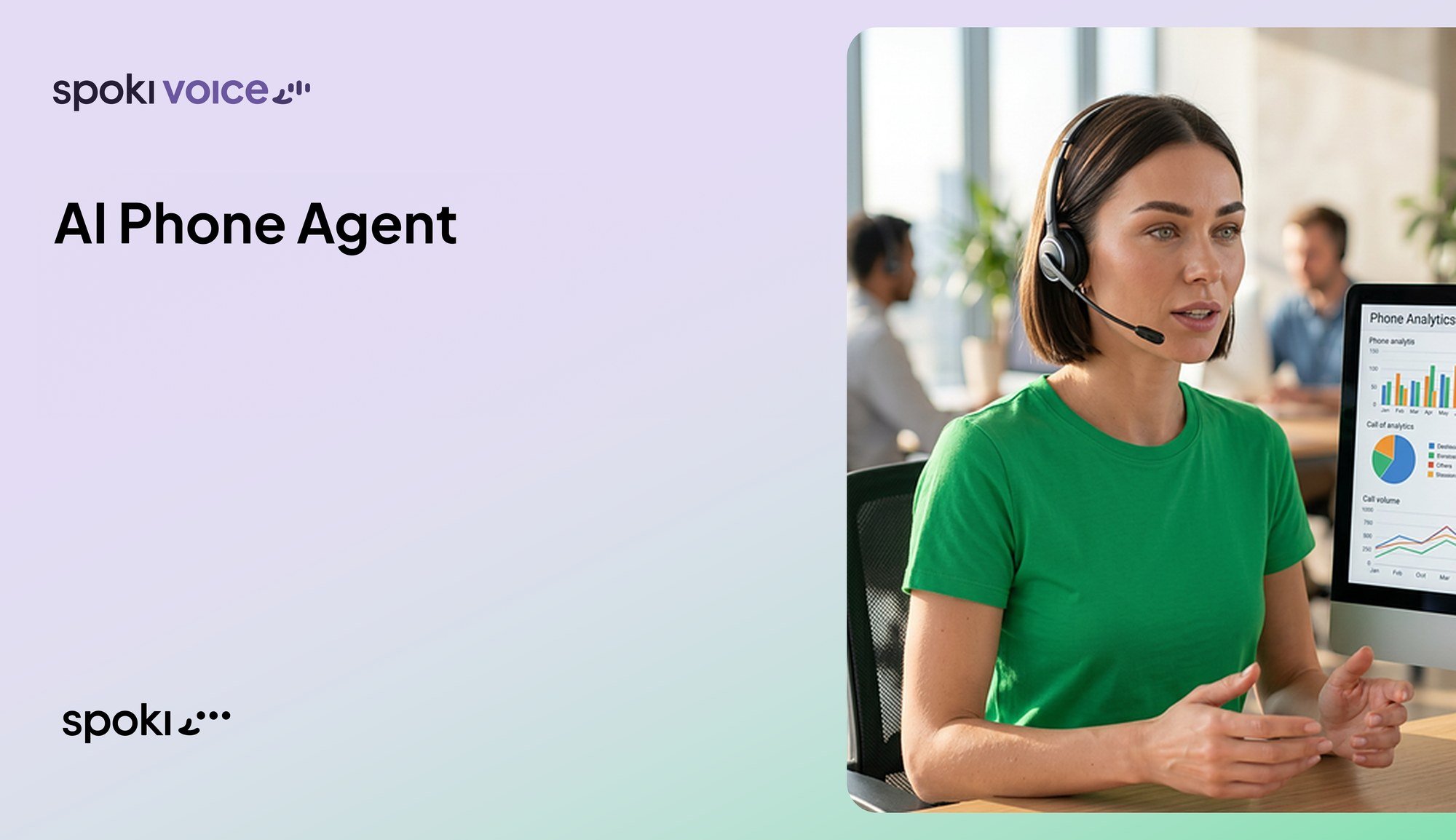
An AI phone agent is an AI voice agent that works on a phone line: it answers and makes calls for a business, speaks with people in natural language and completes tasks during the call, such as answering questions, qualifying leads, booking appointments, creating orders or opening support tickets, and then records the outcome in the CRM. Think of it as a digital team member dedicated to the phone: available 24/7, able to handle several calls at once, and able to hand the conversation to a person whenever a human adds more value.
This guide explains what an AI phone agent is, how it works on inbound and outbound calls, how it differs from related terms, what it can and cannot do, what to check before choosing one and how to launch it step by step.
If you are new to the topic, start with what an AI voice agent is and how an AI voice agent works.
What is an AI phone agent?
An AI phone agent is software that takes on the phone work a person would normally do: picking up incoming calls, calling customers back, following up on leads and reminding people of appointments. Instead of a recorded menu, the caller hears a natural voice that understands free speech, asks follow-up questions and reacts when the caller interrupts.
Four building blocks make an AI phone agent work:
- A phone connection. A business number (existing and forwarded, or a new virtual number) so the agent can receive and place real calls.
- Conversation AI. Speech recognition to understand the caller, a language model to reason and decide, and text-to-speech to answer with a natural voice.
- Tools and actions. Connections to the calendar, the CRM, the order system or the help desk, so the agent can actually do things, not just talk.
- Memory and context. Access to the customer record and previous conversations, so the agent knows who is calling and what happened before.
The phone is still one of the channels customers use when something matters to them: a booking, a problem, an urgent question, a purchase decision. An AI phone agent makes sure those moments are never lost because nobody was free to pick up.
AI phone agent vs related terms
Several terms are used almost interchangeably. This table shows how they usually differ.
| Term | What it usually means | Main focus |
|---|---|---|
| AI voice agent | Any AI that converses by voice (phone, web, app, kiosk) | The technology |
| AI phone agent | An AI voice agent working on a phone line, for inbound and outbound calls | The role on the phone |
| AI phone answering service | An AI that answers incoming business calls | Inbound calls only |
| AI receptionist | An AI that greets, routes and books, like a front desk | Front-desk tasks |
| AI phone system | The whole telephony setup (numbers, routing, agents, analytics) with AI built in | The infrastructure |
In short: the AI phone system is the infrastructure, the AI phone agent is the “person” on the line. For the other sides of the topic, read our guides on the AI phone system, the AI phone answering service and the AI receptionist.
How does an AI phone agent work?
Every call follows the same loop, repeated many times per conversation, in real time.
On an inbound call
- The call reaches the agent, directly on a virtual number or through forwarding from your existing number, at any hour or when your team is busy.
- The agent greets the caller in your brand’s tone and, as good practice, says it is an AI assistant.
- Speech recognition converts what the caller says into text while they speak.
- The language model understands the intent (“I need to move my appointment”), checks the instructions and knowledge you have given it and decides the next step.
- Actions run through integrations: the agent checks availability, moves the booking, looks up an order or creates a ticket.
- Text-to-speech replies in a natural voice, in the caller’s language.
- After the call, the transcript, a summary and the outcome are saved to the customer record, and a confirmation can be sent by WhatsApp, SMS or email.
On an outbound call
Outbound works the other way round. A trigger starts the call: a new lead fills in a form, an appointment is tomorrow, a quote has not been answered, a contact in an old list has never been called back. The agent calls, introduces itself, follows a goal (qualify, confirm, reschedule, collect feedback), handles objections within the limits you set, logs the result and schedules a retry if nobody answers.
What makes the conversation feel natural
Three technical factors decide whether a call feels like talking to a person or to a machine:
- Latency, the pause between the end of the caller’s sentence and the start of the answer. Long pauses make people talk over the agent or hang up.
- Turn-taking, the ability to stop when the caller interrupts and pick up the thread again.
- Background noise, because many people call from the car, the street or a shop floor.
For reference, Spoki Voice has end-to-end latency under 600 ms and includes noise cancellation that allows calls in very noisy environments (figures confirmed by Spoki).
What can an AI phone agent do?
The most useful AI phone agents do not just answer: they complete the task. These are the most common jobs, split by call direction.
| Call type | Typical tasks | What it needs to be connected to |
|---|---|---|
| Inbound: questions | Opening hours, prices, policies, order status | Up-to-date knowledge base, order system |
| Inbound: bookings | Book, move or cancel appointments, test drives, tables | Calendar or booking system |
| Inbound: support | Collect details, solve simple issues, open tickets | Help desk or CRM |
| Inbound: sales | Qualify the request and pass hot leads to sales | CRM and qualification rules |
| Outbound: speed-to-lead | Call new leads within minutes of a form or ad | Lead sources and CRM |
| Outbound: reminders | Confirm or reschedule appointments, reduce no-shows | Calendar |
| Outbound: reactivation | Call old contacts and find renewed interest | CRM lists and segments |
| Outbound: feedback | Short surveys after a purchase or a visit | CRM and survey fields |
A real example of outbound reactivation: in a car dealership case published on this blog, an AI voice agent worked 3,000 old contacts the call centre had never reached and generated 40 qualified leads (read the dealership case). On the inbound side, a veterinary clinic saw missed calls fall from 68% to 4% (AI voice agents for clinics). Both are Spoki-reported results, not independent studies, but they show which metrics are worth tracking.
Benefits and limits of an AI phone agent
Benefits
- No missed calls. Every call is answered, at lunchtime, at night and during peaks.
- Speed. Leads are called back in minutes, not days, and callers do not wait on hold for simple questions.
- Clean data. Each call becomes a structured CRM record with transcript, summary, tags and outcome.
- Scale without hiring for peaks. Several calls run in parallel, so seasonal spikes or campaigns do not overwhelm the team.
- Consistency. The same correct information and the same process on every call, in several languages.
- Better use of people. Your team spends time on negotiations, complaints and complex cases instead of repetitive calls.
Limits to plan for
- Setup quality decides results. Outdated information or missing integrations frustrate callers. Treat the knowledge base like a product that you update every week.
- Not every call should be automated. Complaints, sensitive health, legal or financial topics and high-value negotiations need a clear handover to a human.
- Outbound calls have rules. Consent and calling rules vary by country. In the EU, personal data must be processed lawfully under the GDPR, and the AI Act sets transparency obligations for AI systems that interact with people. In the United States, the FCC confirmed in February 2024 that AI-generated voices in robocalls fall under the Telephone Consumer Protection Act, so prior consent rules apply. If the call happens on WhatsApp, Meta’s Business Calling API lets a business call a user only after that user has granted call permission.
How to choose an AI phone agent
Use these criteria when you compare providers. Test with real calls rather than demos alone.
- Conversation quality. Response speed, natural voice, interruptions, accents and noisy environments.
- Languages. The agent should understand and speak every language your customers use.
- Inbound and outbound. Can the same agent answer calls and also run callbacks, reminders and campaigns with retries?
- Real actions. Booking, order creation, ticketing, lead qualification and segmentation, not just message taking.
- CRM and integrations. Calls should update the customer record your team already uses, through native connectors, webhooks or automation tools.
- Omnichannel follow-up. After the call, the conversation should continue on WhatsApp, SMS or email in the same customer thread.
- Handover. Transfer rules, context passed to the person who picks up and a fallback when nobody is available.
- Compliance. Data location, data processing agreement, recording settings, AI disclosure and consent management for outbound.
- Analytics. Outcomes, call reasons, unresolved questions and billed minutes, so you can improve the agent and control costs.
- Pricing model. Per minute, per call or subscription, plus numbers and setup. Our guide on how much an AI voice agent costs breaks this down.
For a broader evaluation framework, see how to choose the right AI voice agent for your business.
How to launch an AI phone agent in 6 steps
- Map your calls. Group the last few weeks of calls by reason: questions, bookings, orders, support, sales. Do the same for the calls your team should make but does not have time for.
- Pick two or three first flows with high volume and clear rules, for example appointment booking plus lead callbacks.
- Write the playbook for the agent: tone, knowledge, qualification questions, what it may and may not promise, and when to transfer.
- Connect your tools: calendar, CRM, order system or help desk, and the messaging channels for confirmations.
- Define consent and handover rules, including outbound calling hours, retries, opt-outs and who takes over complex calls.
- Test, launch and review weekly. Listen to real calls, fix gaps in the knowledge, and track answered calls, resolution rate, bookings, qualified leads and transfers.
Where Spoki Voice fits
Spoki is the agentic conversational CRM. It brings voice, WhatsApp, SMS and email together in a single thread per customer, and its AI agents answer calls and messages instantly, qualify opportunities, book appointments and keep the CRM up to date, so your team steps in only when it adds value.
As an AI phone agent, Spoki Voice answers every call and can also run outbound calls. During the conversation it can segment contacts, qualify leads, book appointments, create orders and provide customer support. Because it is connected to the whole Spoki CRM and to every channel, the conversation can continue on WhatsApp, the channel many customers trust most, with a confirmation, a reminder or a link right after the call. Spoki Voice can be bought standalone, without WhatsApp, and Spoki connects to 4,000+ tools. Spoki Voice usage starts from about €0.03 plus €0.10 per minute when an AI agent answers; you can check the current plans on the pricing page and start with a free trial, no credit card required. Spoki is an official Meta Business Partner and helps companies around the world at every stage of the customer journey, from marketing to sales and support.
FAQ
What is an AI phone agent?
It is an AI voice agent that works on a business phone line. It answers and makes calls, understands natural speech and completes tasks during the call, such as answering questions, booking appointments, qualifying leads or creating orders, and records the outcome in the CRM.
What is the difference between an AI phone agent and an AI voice agent?
An AI voice agent is any AI that converses by voice, on the phone, the web or in an app. An AI phone agent is an AI voice agent applied to phone calls, inbound and outbound, with a phone number and integrations with business tools.
Can an AI phone agent make outbound calls?
Yes. It can call new leads, confirm appointments, reactivate old contacts or run short surveys, with retries when nobody answers. Outbound calls must follow consent and calling rules in each country.
Does an AI phone agent replace my team?
No. It takes over repetitive, predictable calls and hands complex or sensitive conversations to a person, with the context of the call, so your team can focus on the conversations where they add the most value.
Do callers have to know they are talking to an AI?
Being transparent is good practice, and in the EU the AI Act includes transparency obligations for AI systems that interact with people. A short disclosure in the greeting is usually enough.
Can I keep my current phone number?
In most cases yes: you forward calls from your existing number to the agent, or you use a new virtual number connected to the platform.
Can I use Spoki Voice without WhatsApp?
Yes. Spoki Voice can be bought standalone and stays connected to the Spoki CRM and to other channels if you add them later.
Conclusion
An AI phone agent turns the phone from a bottleneck into a channel that always answers, calls back in time and leaves a clean record of every conversation. Start with your most frequent calls and the callbacks your team never gets to, connect the agent to your calendar and CRM, define clear handover and consent rules, and measure results from day one. Spoki is the agentic conversational CRM, and Spoki Voice is built to answer every call and keep the conversation going across channels.
📘 Download the Playbook: want proven use cases, call scripts and best practices to launch your AI phone agent? Download the Spoki Voice Playbook.
Sources (checked 23 November 2026)
- European Commission, transparency obligations under Article 50 of the AI Act
- General Data Protection Regulation (EU) 2016/679, EUR-Lex
- FCC, “FCC Makes AI-Generated Voices in Robocalls Illegal”
- Meta for Developers, WhatsApp Business Calling API
- Spoki Voice and Spoki pricing pages
- Spoki Voice latency (under 600 ms end-to-end) and noise cancellation: confirmed by Spoki
- Spoki-reported case results: car dealerships and clinics