Spain’s new customer service law: what Ley 10/2025 requires
Content
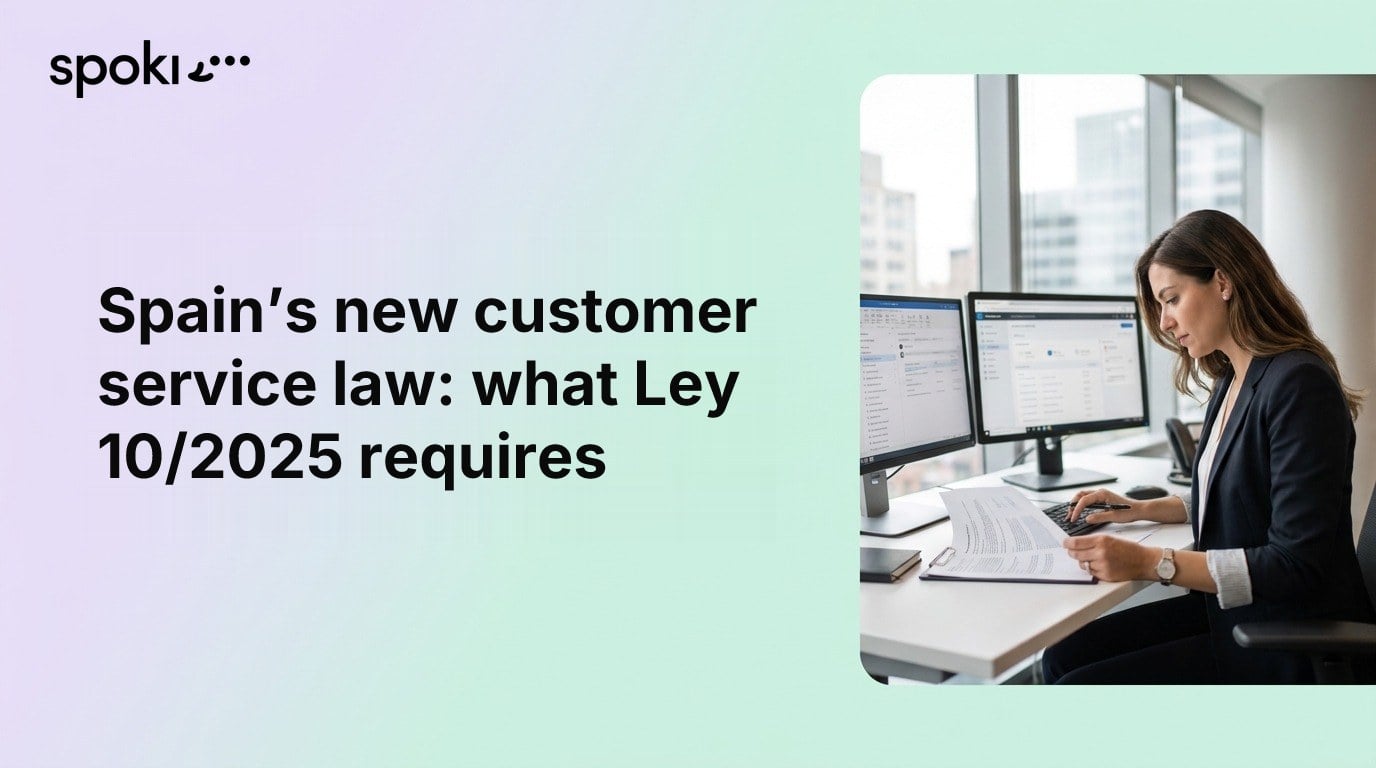
In regulated industries, customer service quality is no longer a competitive edge: it is a compliance requirement. Spain’s Ley 10/2025 of 26 December, regulating customer service (Ley 10/2025, de 26 de diciembre, por la que se regulan los servicios de atención a la clientela) came into force on 28 December 2025 and, for the first time, sets mandatory response times measured in hours, with an annual external audit and fines of up to one million euros.
Companies get twelve months to adapt, ending on 28 December 2026. That leaves just over three months. Here is what the law requires, who it applies to and what you need to build to be ready in time.
Table of contents
- Which companies does it apply to?
- The four mandatory deadlines
- Can you serve customers with AI or chatbots alone?
- What else the law requires
- The cost almost nobody is calculating
- Penalties
- How Spoki helps
- Four steps before December
- Frequently asked questions
Which companies does it apply to?
You fall within the scope of Spain’s new customer service law if either of these applies to you:
- You provide a basic service of general interest in Spain (water, energy, passenger transport, postal services, electronic communications or financial services), regardless of your size. In these sectors, specific sector regulation still prevails where it exists.
- You are a large company selling to consumers in Spain and in the previous financial year you reached at least one of these thresholds: 250 employees, more than 50 million euros in annual turnover or more than 43 million euros in total assets.
If you are an SME, the law does not bind you. It is still worth reading: these deadlines will become the default expectation of every Spanish consumer, and they will flow down the contract chain to anyone selling to a large company as a supplier.
The four mandatory deadlines
These are obligations of result, not of effort.
| Type of contact | Maximum time |
|---|---|
| Incidents affecting service continuity | 2 hours |
| Billing issues and undue charges | 5 days |
| All other queries, complaints and claims | 15 working days |
| Waiting time on phone support | 95% of calls in under 3 minutes on average |
Two more rules change internal processes: the law bans dropping calls because of long waiting times, and it bans closing a complaint simply because time has passed. Every complaint needs a specific, reasoned answer. Silence is no longer a way out.
Can you serve customers with AI or chatbots alone?
No. The law expressly prohibits using automated answering systems or similar means as the exclusive channel of customer service.
It is worth reading precisely, because it is often summarised badly: the law does not ban AI or chatbots. Automation remains legal; what is not legal is automation being the only door. You must guarantee direct human interaction whenever the customer asks for it and, if they are still not satisfied, let them reach a supervisor within the same conversation or on the same working day.
It is also the easiest breach to spot from the outside: just type “I want to talk to a person” and see what happens. How to design that handover (the five failure modes and what to log for each one) is covered in AI-to-human escalation.
What else the law requires
- Four contact channels: post, phone and electronic, plus the same channel through which the contract was signed. If someone signed up with you on WhatsApp, you cannot force them to complain by letter.
- Free and accessible: a call cannot cost more than a national call at a geographic or mobile rate, with service in the relevant co-official language, replies in the language the customer writes in, and enhanced accessibility for older people, people with disabilities or people in vulnerable situations.
- Reference code and receipt: every query, complaint or incident needs an identifier with a trackable status, and a receipt on a durable medium.
- Annual external audit: an annual evaluation system with objective indicators, audited every year by a firm accredited by ENAC (Spain’s national accreditation body) that verifies the measurement error does not exceed 5%. Records must be kept for five years.
- 24/7 for outages: for basic services provided on a continuous basis, the channel for reporting continuity incidents must be available every day of the year.
The cost almost nobody is calculating
The headlines have focused on the three minutes on the phone. But the two toughest deadlines are not customer service problems:
The 2 hours for service continuity is an operations deadline. Nobody in customer service fixes an outage: they detect it, escalate it and communicate. Meeting it requires the alert to reach field teams and come back with an answer within the same window.
The 5 days for billing is a finance deadline. An undue charge is fixed in the billing system, not in the chat.
In other words, the law breaks down silos by decree. And it brings two consequences worth budgeting for now. First, manual processes that cannot be audited stop being good enough: if the trail of a case lives in a shared inbox and in the memory of whoever handled it, there is no audit to pass. Second, serving customers on the channel where they signed up requires true omnichannel, not one more channel next to the others: same case, same identifier, same history, wherever it comes in. Seen another way, the project the law forces you to pay for is the same one your customer experience strategy needs; we explain this in how to turn compliance into a competitive advantage.
Penalties
The law does not create its own fines: it refers to the general consumer penalty regime of Spain’s consolidated General Law for the Protection of Consumers and Users (texto refundido de la Ley General para la Defensa de los Consumidores y Usuarios).
| Type of infringement | Fine |
|---|---|
| Minor | €150 to €10,000 |
| Serious | €10,001 to €100,000 |
| Very serious | €100,001 to €1,000,000 |
In all three bands the fine can exceed the cap and reach between two and eight times the unlawful profit obtained, and very serious infringements can carry additional penalties, including temporary closure for up to five years.
There is a cost that does not appear in the BOE (Spain’s Official State Gazette): the reference code and durable receipt the law requires you to issue are, in practice, documentary evidence. The traceability you build to comply is the same traceability a customer can use against you.
How Spoki helps
Spoki is a Customer Engagement Management platform built on Meta’s official WhatsApp Business API, with AI, voice, SMS and email in a single inbox. We do not sell compliance in a box: it does not exist. We cover the operational side where the law bites.
- The electronic channel, where your customer already is. WhatsApp has a 98% open rate compared with 20-25% for email: it is the channel that creates the least friction and drives the fewest calls. And if the contract was signed on WhatsApp, the law requires you to provide support there.
- Resolve repetitive requests without a queue. AI agents for customer service detect intent, analyse sentiment and reply in the language the customer writes in, with automatic translation into more than 40 languages. Order status, duplicate invoices, appointments or cancellations get resolved without eating into the 15-day clock.
- Escalation to a person, which is what the law requires. AI is not a wall: any conversation can move to a human agent in the same inbox, with orders, history and CRM data in front of them. The customer does not repeat anything, and the supervisor joins the same thread on the same day. See customer care solutions.
- The phone, the hardest SLA. Spoki Voice (AI-powered inbound IVR and outbound dialer, generally available) answers on the first ring and resolves or transfers. It helps you sustain 95% under three minutes with no queue and cover 24/7 outage reporting. If you come from a traditional contact center: AI for call centers.
- Traceability and audit data. Every conversation has an identifier, timestamp, channel, agent and status; automations send the reference code and receipt when the case is opened. With WhatsApp CRM and more than 100 native integrations, the case also lives in your system of record, which is where the auditor will look for it. Official Meta Tech Partner, GDPR-native and EU data residency for the five-year retention period.
What Spoki does not do, just as clearly: it does not give you the postal channel, it does not replace a phone line staffed by people, it does not carry out your ENAC audit and it does not write your indicator system. Complying with Ley 10/2025 is a process, organisational and legal project. What a platform can do is make the deadlines sustainable with the team you already have.
Four steps before December
- Confirm the fit with legal. Thresholds, sector and which sector-specific rules apply to you before this one.
- Measure the gap. Your actual response times today by channel and case type, against the four deadlines. Without a baseline you do not know how far you are.
- Close the technical gaps. A route to a person in every automated flow, a reference code with trackable status, and a single case that survives a change of channel.
- Set up auditable metrics and hire the auditor. The law’s indicators, exportable, with five-year retention validated with your DPO. 28 December will not be a good day to start looking for an accredited auditor.
Frequently asked questions
When does Spain’s new customer service law come into force?
Ley 10/2025 came into force on 28 December 2025. Affected companies have a twelve-month adaptation period, so the compliance deadline is 28 December 2026.
Which companies does Ley 10/2025 apply to?
It applies to companies providing basic services of general interest in Spain (water, energy, passenger transport, postal services, electronic communications and financial services) regardless of their size, and to large companies selling to consumers in Spain that reach at least one of these thresholds: 250 employees, more than 50 million euros in annual turnover or more than 43 million euros in total assets.
Can you serve customers with only a chatbot or AI?
No. The law prohibits using automated answering systems or similar means as the exclusive channel of customer service. Automation and AI are legal, but you must guarantee direct human interaction when the customer asks for it, and allow escalation to a supervisor within the same conversation or on the same working day.
How long do you have to answer a complaint under the new law?
The general deadline is 15 working days. Billing issues and undue charges have a 5-day deadline, and incidents affecting service continuity must be answered within 2 hours at most. In addition, a complaint cannot be closed simply because time has passed: it requires a specific, reasoned answer.
What are the penalties for breaching the customer service law?
The law refers to Spain’s general consumer penalty regime: €150 to €10,000 for minor infringements, €10,001 to €100,000 for serious ones and €100,001 to €1,000,000 for very serious ones, with the possibility of exceeding those caps up to eight times the unlawful profit obtained and of imposing additional penalties such as temporary closure.
Start by measuring
Ley 10/2025 does not ask for friendliness: it asks for deadlines, traceability and proof. All three are built on data, not on your team’s goodwill.
Of the four deadlines, the phone one (95% of calls answered in under three minutes) is the one most teams will miss. If you want to hear what an AI voice agent covering that gap sounds like before deciding anything, download the Spoki Voice playbook below and request a demo call: the agent calls you.
Sources
- Ley 10/2025, de 26 de diciembre, por la que se regulan los servicios de atención a la clientela, consolidated text: BOE-A-2025-26698
- Ministerio de Derechos Sociales, Consumo y Agenda 2030 (Spanish Ministry of Social Rights, Consumer Affairs and 2030 Agenda): objectives and measures of the Customer Service Law
- Consumer penalty regime: art. 49 of the consolidated text of the Ley General para la Defensa de los Consumidores y Usuarios
This article is for information purposes only and does not constitute legal advice. To assess how Ley 10/2025 affects your company, consult your legal advisers.
Last updated: 29 September 2026.